Sits on the WMS you already run
Blue Yonder, Manhattan, SAP EWM and Korber stay in place doing what they are good at: stock, locations, allocation and waves. Opsima adds what sits above them, which is where most of the daily friction actually lives.
The equipment doing the work, the events that never reach a scanner, and one view across buildings your WMS treats separately. Blue Yonder, Manhattan and SAP EWM stay exactly where they are.
The category
A warehouse management system (WMS) controls what happens to stock inside a building. It records what arrived, where it went, what is allocated to which order, and what gets picked next. Blue Yonder, Manhattan, SAP EWM and Korber are the established platforms, and any operation of size already runs one of them.
They are good at that job. What they were not designed for is everything around it: the reach truck running the task, the damaged pallet moved by hand at 03:00, the trailer that turned up without an appointment, and the second building running the same software under different definitions.
The gap
Two buildings run the same WMS and nobody can compare them without exporting both.
Stock accuracy is reported as a number and never traced to what causes the variance.
A reach truck goes out of service mid-wave and the tasks it held sit there.
A trailer arrives without an appointment and the rest of the day gets rebuilt around it.
None of those are WMS failures. They are things that happen outside what a WMS was built to see, which is why replacing it fixes none of them.
Capabilities
Nine areas, all of them things that sit above stock and locations rather than replacing them.
Blue Yonder, Manhattan, SAP EWM and Korber stay in place doing what they are good at: stock, locations, allocation and waves. Opsima adds what sits above them, which is where most of the daily friction actually lives.
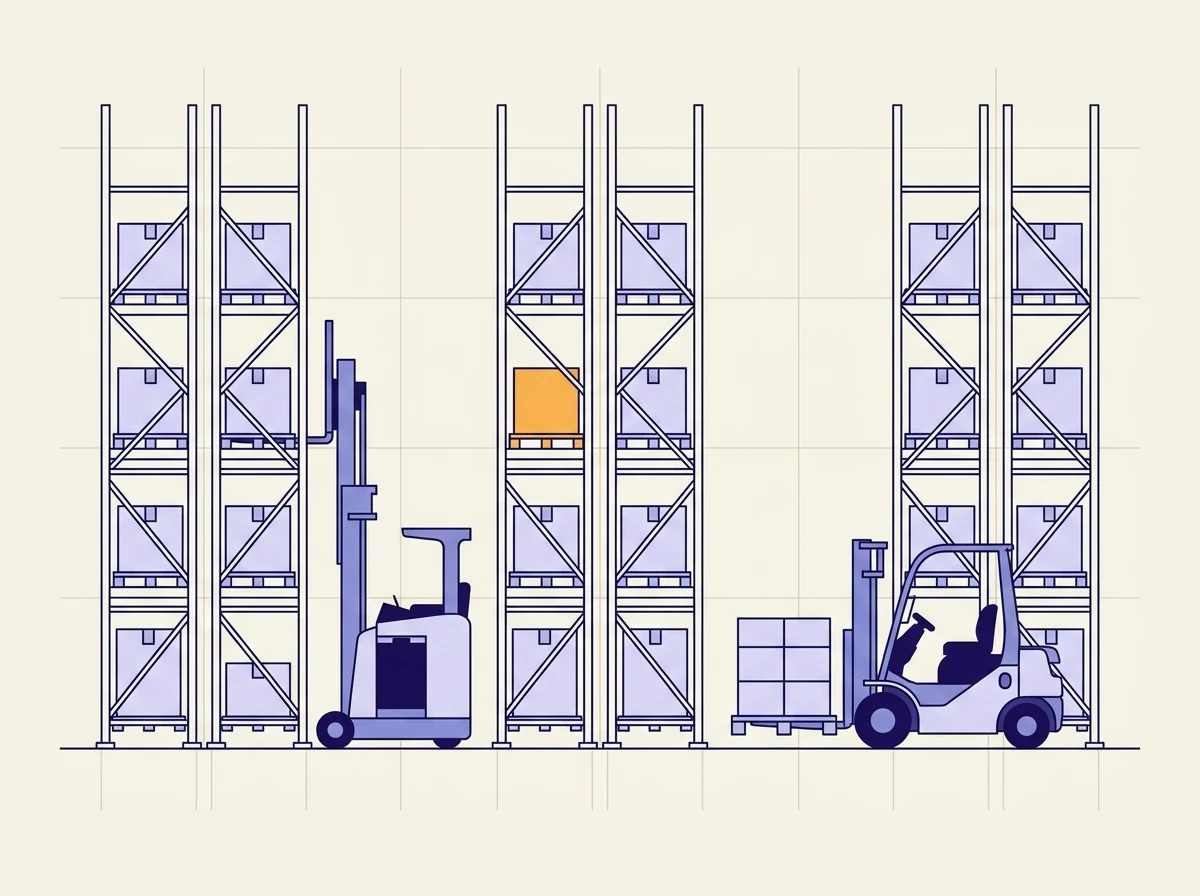
Reach trucks, counterbalance forklifts and order pickers linked to the work they are running, with service state and battery charge alongside. A WMS assigns the task competently and rarely knows the unit is twenty minutes from stopping.
Variance traced back to what caused it rather than reported as a percentage. Returns put away by hand, replenishment moved off-system and damaged stock relocated without a scan account for most of it, and none of those touched a scanner.
Time split into picking, travelling and waiting, per wave. Travel almost always beats picking, and the waves where waiting spikes usually point at a replenishment that did not happen rather than at the pickers.
Pick velocity mapped onto the layout, so the lines that get picked forty times a shift from the far end of aisle D become visible. Slotting decisions are usually made once and then left alone for years.
Inbound and outbound scheduled against the doors and the labour available to work them. The unbooked trailer that turns up at 11:00 and absorbs a door for two hours is the event that reorganises the rest of the day.
The shift plan set against the work that is inbound, so being short from 10:00 is something you see the day before. A flat roster against a lumpy day is the most common cause of overtime nobody planned.
Run hours read from the trucks and fed into the service schedule, so material handling equipment is maintained on real use. Mixed fleets are normal here, and a plan that only covers the telematics-equipped units is not a plan.
SAP, Oracle, Priority and NetSuite stay your system of record for stock value and orders. Opsima writes structured operational records back into them alongside the WMS, rather than becoming a third place to look.
The difference
When a distribution operation is frustrated with its warehouse system, the proposal that arrives is normally a replacement. Those projects run for a year or more, consume the operations team, and carry real risk of a bad go-live in a building that has to ship every day.
It is worth asking what would actually change. Stock, locations, allocation and wave planning are the core of a WMS, and the established platforms do them well. A replacement mostly buys a different interface to the same functions.
The daily friction sits elsewhere. It is the reach truck that went down mid-wave, the return put away outside the process, the trailer nobody booked, and the fact that two buildings running identical software cannot be compared without a spreadsheet. Opsima builds that layer on top and leaves the core alone. It is a smaller project, it ships in weeks, and if it does not earn its place you have not bet the operation on it.
In the field
That is a container terminal rather than a distribution centre, and the mechanism transfers directly: the events that decide the day were always happening, and almost none of them were reaching a system. Taavura's Earth Moving Division runs the same layer across quarries and infrastructure sites.
Delivery
Your WMS keeps running the building. Opsima adds the equipment layer, the off-system events and the cross-site reporting on top, and writes structured records back down. Nothing your team touches daily changes, and IT reviews and signs off the rollout in staging before it goes live.
A full replacement makes sense in a narrow case: a small site running on spreadsheets, or an operation whose processes no packaged WMS fits. If you are running Blue Yonder, Manhattan or SAP EWM across a real distribution network, this is probably the wrong conversation and we will say so.
Goes deeper
FAQ
Bring the process where the paperwork and the shelf disagree most often. We build it on your real data and run it with you. You pay only after it goes live.