MINING AND QUARRY OPERATIONS

Personalized software to run your mining operation.

Production-grade ops software, built to fit on top of Modular Mining DISPATCH, Wenco, Hexagon, or whichever fleet system you already run. We build it. We deploy it. You pay only after it goes live.
  • Built to fit your mine site
  • Live in weeks, not quarters
  • Pay only when it works
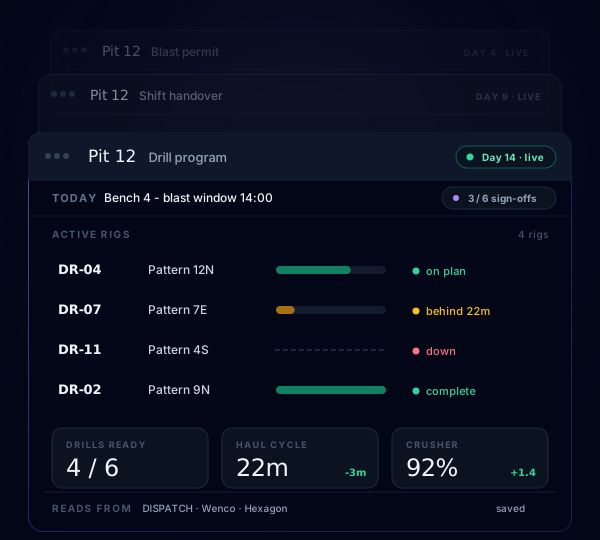
Opsima ops layer reading live data from Modular Mining DISPATCH, Wenco, and Hexagon, surfacing drill availability, haul cycle, and crusher feed.

Mining has a data problem, not a technology problem.

Every drill, shovel, and haul truck generates data. But when fleet management, maintenance, dispatch, and planning each run in their own system, that data never adds up to decisions.

-50%

drop in mining productivity since 1997, while manufacturing productivity more than doubled (OECD data, via McKinsey, Dec 2025)

1%

per annum mining productivity growth since 2018, supported by the adoption of digital technologies

500

senior mining leaders identify siloed data and the limited integration between operations and maintenance as key barriers to digital ROI

Sources: McKinsey "Unearthing a new era of innovation in mining" (Dec 2025, citing OECD productivity data); McKinsey "Global Materials Perspective 2025" (Dec 2025); EY "Top 10 Business Risks and Opportunities for Mining and Metals" (Oct 2025, n=500 unique responses).

Each capability ships personalized to your pit, your fleet, your stack.

Same ops layer over Modular Mining, Wenco, Hexagon, or your CMMS. Personalized to how your shift actually runs.

BLAST PREP

Drill availability synced to the blast plan

Drill status updates the moment a rig goes down or comes back online. Blast schedulers see drills available right now, not at 06:00 this morning.

HAUL CYCLE

Live truck status across every ramp

Operators report breakdowns. Dispatch sees it instantly. No more allocating loads to a truck that has been sitting on the ramp for two hours.

MATERIAL FLOW

Pit to plant in one continuous view

Crusher feed, conveyor uptime, stockpile cover. All visible alongside the trucks feeding them. Bottlenecks visible before they cascade.

FLEET UPTIME

MTTR per asset class, calculated continuously

Captured from field communication, not paper shift books. SAP PM and Maximo get the structured record with real timestamps and parts used.

CREW CHANGE

Handover in 2 minutes, not 45

Incoming foreman opens a dashboard with active breakdowns, deferred maintenance, and parts on order. No more reconstructing the night shift at 05:45.

MULTI-PIT, MULTI-FLEET

Built for Cat, Komatsu, Liebherr and mixed fleets

Asset names from any OEM, across multiple pits and processing plants, mapped to your master register automatically.

Three breakdowns that compound every shift.

The Blast Prep Blindspot

Drilling supervisors commit to blast schedules based on drill availability received from a morning radio check. If a rig goes down after 06:00, the blast planner finds out when the shift supervisor calls at noon.

"I've had blast prep delayed by four hours because a drill went down at 08:30 and nobody updated the board. I had crews standing by."

Mine Planning Manager

The Haul Truck Black Hole

A haul truck breaks down on the ramp. The operator calls it in. The mechanic radios ETA. Three hours later, the dispatch board still shows it as active because nobody updated the CMMS.

"Dispatch is allocating loads to a truck that's been sitting on the ramp for two hours. We only find out when the operator calls dispatch directly."

Mine Operations Superintendent

The Crew-Change Gap

Mining operations run 12-hour shifts on remote sites. At crew change, the outgoing foreman's knowledge transfers verbally in five minutes or not at all.

"We lose the first 45 minutes of every shift to equipment verification. In remote ops, that's two production cycles gone."

Site Maintenance Planner

A live equipment status board built from field communication.

Every status update sent over WhatsApp, radio, or email becomes a tile on this board. Operations knows what is available right now: not what was available an hour ago.

Mine Site Overview LIVE
Available: 0
In Maintenance: 0
Breakdown: 0
Reserved: 0
HT-01
Haul Truck
Available
HT-02
Haul Truck
Available
HT-03
Haul Truck
Breakdown
HT-04
Haul Truck
In Maintenance
DR-01
Rotary Drill
Available
DR-02
Rotary Drill
Reserved
DR-03
Rotary Drill
Breakdown
SH-01
Hydraulic Shovel
Available
SH-02
Hydraulic Shovel
In Maintenance
BL-01
Bulldozer
Available
BL-02
Bulldozer
Available
WL-01
Wheel Loader
In Maintenance
WL-02
Wheel Loader
Available
CR-01
Jaw Crusher
Available
CV-01
Conveyor Primary
Breakdown
GR-01
Motor Grader
Reserved

The repair gets reported. The record writes itself.

Field communication flows through Opsima and becomes a structured work order automatically. No forms. No data entry. No end-of-shift catch-up.

Mine M&R Crew
Operator
HT-03 down, left rear axle seal failure, km 14 ramp
07:22
Dispatcher
Copy, who's attending?
07:24
Fitter
En route, parts ETD from workshop 45 min
07:25
Fitter
Parts on site, repair started
08:11
Asset HT-03
Fault type Axle seal failure
Location Km 14 ramp
Technician Fitter
Parts used Rear axle seal kit
Fault reported 07:22
Work started 08:11
Work Order Record Created
Asset HT-03
Fault type Axle seal failure
Location Km 14 ramp
Technician Fitter
Parts used Rear axle seal kit
Fault reported 07:22
Work started 08:11
Synced to CMMS

What changes when operations and maintenance share one source of truth.

Blast scheduler uses drill availability from 06:00 check, 4 hours stale by 10:00
Drill status updates in real time as field teams radio or message status changes
Haul truck down on ramp. Dispatch keeps allocating loads for 2 hours
Breakdown visible to dispatch the moment the operator calls it in
Crew-change debrief is verbal and loses detail
Incoming foreman opens a dashboard with all active breakdowns, deferred maintenance, and parts on order
MTTR compiled from paper shift books at month end
MTTR per asset class calculated continuously from captured field messaging
PM scheduled against calendar, not actual running hours
Meter-based PM triggers fire from running hours reported in field communication
SAP PM records lag 3+ days behind actual maintenance events
SAP auto-populated from structured Opsima capture with timestamps intact

45 minutes spent reconstructing what happened is 45 minutes of production decisions made on assumptions.

Every crew change starts with a knowledge gap. The outgoing foreman knows what happened. The incoming foreman has to reconstruct it. Opsima makes the handover instant.

Without Opsima
06:00
HT-01
?
HT-02
?
DR-01
Available
DR-02
?
SH-01
?
WL-01
?
CV-01
?
GR-01
?
Check with departing foreman. HT-03 and DR-03 had issues overnight. CV-01 feed may be restricted.
Handover complete: 45 minutes
With Opsima
05:45
HT-01
Available
HT-02
Available
HT-03
Breakdown
DR-01
Available
DR-03
Breakdown
SH-01
Available
CV-01
Breakdown
GR-01
Reserved
3 active breakdowns
Parts on order: HT-03 axle seal (ETA 08:00)
2 items deferred from night crew
Handover complete: 2 minutes

Overlays your existing CMMS and dispatch systems. Live in 3 days.

Opsima does not replace SAP PM, Maximo, or your dispatch system. It captures the unstructured operational data flowing around those systems and feeds structured records back in.

Integrates with SAP PM, Maximo, Pronto, MainPac

Equipment status updates and maintenance records flow directly into your existing platforms. No migration. No parallel system.

Maintenance records auto-structured from field radio and WhatsApp communication

No parallel data entry. The technician's own communication becomes the structured maintenance record.

No app for operators or fitters

They communicate by radio and message as normal. Opsima reads the output. No behavior change required.

Works across multi-pit, multi-fleet environments

Automatic asset identification across haul trucks, drills, shovels, loaders, and ancillary plant from any OEM.

Questions from operations and maintenance teams

Does Opsima work at remote mine sites with limited connectivity?
Yes. Opsima processes communication data asynchronously. Radio logs and WhatsApp messages are captured when connectivity is available and structured into equipment status records. There is no requirement for continuous real-time connectivity at the pit face.
How does it handle multi-pit, multi-fleet operations?
Opsima recognizes assets across multiple pits, processing plants, and fleet types automatically. Equipment naming variations and informal asset IDs used by operators and fitters are mapped to your master asset register.
We use SAP PM. What does Opsima add to it?
SAP PM captures what coordinators enter, usually hours or days after the event. Opsima captures what technicians communicate at the time of repair. Your SAP system gets richer data: real timestamps, parts actually used, root cause as described by the fitter.
Can it track rotatable components and sub-assemblies?
Yes. Component-level tracking is supported. When a fitter messages about replacing a specific component, that event is captured and linked to both the parent asset and the component record.
How does it handle contractor maintenance crews alongside in-house teams?
Opsima captures communication from all maintenance personnel regardless of employment type. Contractor and in-house work is attributed separately in reporting while feeding the same live status board.
Ready to ship

Personalized ops software for your mine site. Live in weeks, paid for when it works.

Book a working session with our solution team. We map the pit, the integrations, and the timeline before anything else.

SSO Isolated environments Audit trails Dev → Review → Prod