DATA INGESTION
Every ops system in one normalized stream
TOS moves, gate transactions, radio calls, and WhatsApp threads pulled in and normalized into a clean, structured stream your CMMS and your team can act on. Not a replacement, an interpreter.
Production-grade ops software that ingests and normalizes the equipment and operations data your terminal runs on. Plugs into Navis, IBM Maximo, CyberLogitec, and your gate operating system. We build it. We deploy it. You pay only after it goes live.
THE STATE OF PORT OPERATIONS DATA
In Tideworks' and Port Technology International's 2025 global survey of 121 marine terminal professionals, the gap between what terminals know and what is actually happening on the yard is stark.
still rely on manual data practices
lack real-time visibility
use real-time analytics, despite 86% having a TOS in place
Source: Tideworks Technology / Port Technology International, "Maritime Terminal Leaders: Tech Innovation and Digitalisation," 2025 (n=121).
CAPABILITIES FOR CONTAINER TERMINALS
Each capability runs on top of your existing TOS, gate operating system, and CMMS. Nothing rip-and-replace. Nothing your yard staff or technicians have to learn.
DATA INGESTION
TOS moves, gate transactions, radio calls, and WhatsApp threads pulled in and normalized into a clean, structured stream your CMMS and your team can act on. Not a replacement, an interpreter.
YARD COORDINATION
Live equipment state across your container yard. Operations, maintenance, and planning see the same board. No more 'who has what' phone calls between bays.
GATE FLOW
Cut average truck turnaround by tying gate appointments, yard pulls, and inspector capacity to live equipment status. Drivers wait less. Hauliers come back.
EQUIPMENT UPTIME
EquipmentOS, the proven backbone underneath, captures every status change as it happens and feeds it back to planners, maintenance, and TOS users at the same time.
SHIFT HANDOVER
Incoming supervisors get the full picture, not a WhatsApp thread. Active breakdowns, parts on order, deferred maintenance: all live, all current.
WORKS BEYOND CONTAINER
Built for container terminals first because that's where most operations sit, but the platform extends to bulk berths, RoRo ramps, and inland container depots without forking the product.
WHERE TERMINAL OPERATIONS LOSE GROUND
Gang planners need an accurate equipment count. In most terminals, that count comes from a yard walk, a radio check, or a WhatsApp message. By the time it reaches the planning desk, it is 40 minutes old.
"One person tells me 90 tractors are ready. Another says 100. I'm making gang allocations on a number nobody can verify in real time."
Terminal Operations Manager
A crane goes down mid-vessel. The mechanic radios the status and starts hunting parts. For the next 4 to 12 hours, only the repair crew knows what is happening. The CMMS entry comes at end of shift, if at all.
"We have no single place where I can see what is broken, who is working on it, and what is blocking the repair. I find out when the crane comes back online."
Maintenance Manager
Shift handovers are verbal and fast. Active breakdowns, parts on order, and deferred maintenance live in the outgoing supervisor's head and a WhatsApp thread. The incoming shift restarts from partial information every time.
"The incoming shift supervisor spends the first 30 minutes of every shift figuring out what's actually available. That's 30 minutes of decisions made on assumptions."
COO, Container Terminal
WHAT OPSIMA SHOWS OPERATIONS
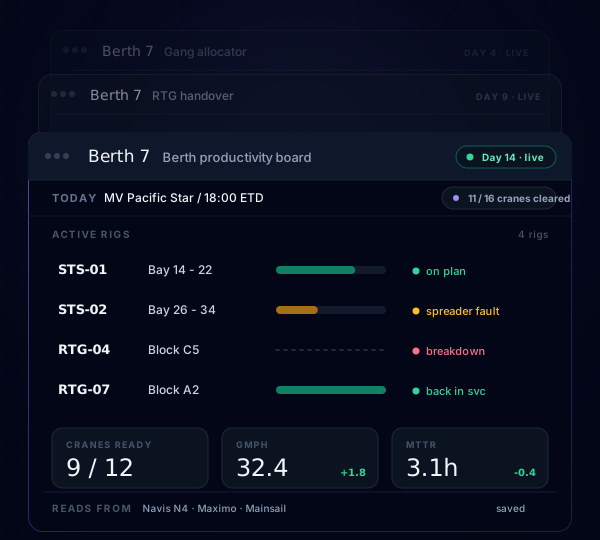
Every status update sent over WhatsApp, radio, or email becomes a tile on this board. Operations knows what is available right now: not what was available an hour ago.
SEE IT IN ACTION
Shift performance, crane uptime, and gate throughput compiled straight from live equipment and operations data. No spreadsheets. No end-of-shift assembly.
60-second walkthrough.
PAIN TO OUTCOME
THE SHIFT HANDOVER GAP
Active breakdowns, parts on order, and deferred maintenance live in the outgoing supervisor's head and a WhatsApp thread. Opsima makes the handover instant.
BUILT ON TOP OF YOUR EXISTING STACK
Opsima ingests and normalizes equipment and operations data from Navis N4, IBM Maximo, CyberLogitec, and your gate operating system. Powered by EquipmentOS, the proven backbone already deployed at terminals moving live volume.
Equipment status updates and maintenance records flow directly into your existing platforms. No migration. No parallel system.
Operators and mechanics communicate the way they always have. Opsima reads the output. No app to install, no form to fill, no behavior change.
RTGs, STSs, reach stackers, top picks, and terminal tractors from Konecranes, Kalmar, Liebherr, and others are recognized automatically. No manual configuration.
No hardware. No on-site installation. Connect to your existing communication channels and see structured equipment data within 72 hours.
FAQ
Book a working session with our solution team. We map the operation, the integrations, and the timeline before anything else.