TURNAROUND TIMING
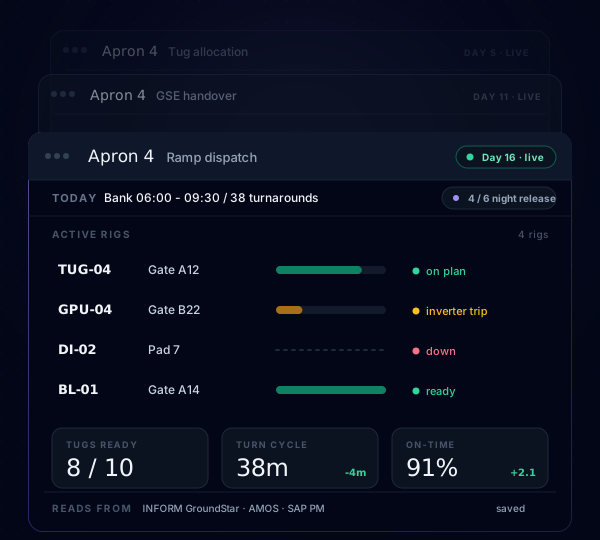
Every stand shows time to push, not just gate status
Pushback, fueling, catering, cleaning, and boarding mapped to a single turnaround bar per flight. Delays surface the moment a service runs over its window.
Production-grade ops software, built to fit on top of INFORM GroundStar, AMOS, SAP PM, or whichever resource and M&E system you already run. We build it. We deploy it. You pay only after it goes live.
THE STATE OF GROUND OPERATIONS
Across the global aviation industry, ground damage, loading errors, and ramp-handling delays remain the largest controllable risks in every turnaround.
aircraft ground damage events reported in 2025, the leading operational and financial risk in turnaround operations
aircraft loading errors reported in 2025; airlines using digital load control and reconciliation cut loading errors by more than 90%
average airline-related delay per flight in 2024 (ramp handling, boarding, staffing) - the second-largest delay driver across the European network
Sources: IATA Press Release, 38th Ground Handling Conference, May 2026 (iata.org); EUROCONTROL CODA Annual Digest 2024, July 2025 (eurocontrol.int).
WHAT CHANGES ON YOUR RAMP
Each capability runs on top of your existing ramp systems. Nothing rip-and-replace. Nothing your ramp agents have to learn from scratch.
TURNAROUND TIMING
Pushback, fueling, catering, cleaning, and boarding mapped to a single turnaround bar per flight. Delays surface the moment a service runs over its window.
GSE FLEET
Ramp controllers see which units are available, which are en route, and which are down. Allocation decisions happen in seconds, not radio calls.
GATE ALLOCATION
When an inbound goes early or late, stand assignments update automatically. Ground crews get the revised plan before the aircraft enters the apron.
GSE UPTIME
Every tug, loader, and deicing truck reports status continuously. Maintenance sees MTTR per unit class. Ops sees available count per stand zone.
CREW HANDOVER
Active delays, grounded GSE, deferred maintenance, and weather holds. All live, all current. No 30-minute radio reconstruction at shift change.
MULTI-OEM FLEET
Asset names from any OEM, across multiple terminals and ramp zones, mapped to your master register automatically.
WHERE GROUND OPERATIONS LOSE GROUND
Turnaround coordinators allocate GSE to gates based on availability boards that update on phone calls. A GPU goes offline between the board update and the push. The crew arrives at the gate to an unavailable unit.
"I had a widebody push delayed 22 minutes because the GPU on Gate 14 was tagged out at 08:10 and nobody updated the coordinator until 08:34."
Ground Operations Manager
Night shifts complete maintenance on tugs, belt loaders, and de-ice units. Whether those items are released to available before 04:30 depends on whether the night supervisor remembers to call it in.
"We start the early morning bank with five pieces of GSE listed as available that are actually still on chargers in the hangar. We find out when the agents go to collect them."
GSE Manager
During winter operations, de-ice units communicate status on a shared radio frequency. When a unit goes down, the information exists nowhere except in the operator's transmission and the coordinator's memory.
"One de-ice unit went down on the remote stand and I didn't know for 34 minutes. In that window I'd already dispatched three aircraft to that pad."
Turnaround Coordinator
WHAT OPSIMA SHOWS OPERATIONS
Every status update sent over WhatsApp, radio, or email becomes a tile on this board. Operations knows what is available right now: not what was available an hour ago.
FROM RADIO CALL TO WORK ORDER
Field communication flows through Opsima and becomes a structured work order automatically. No forms. No data entry. No end-of-shift catch-up.
PAIN TO OUTCOME
THE TURNAROUND COORDINATOR'S PROBLEM
The turnaround plan is only as good as the equipment data behind it. When GSE status is stale, the plan falls apart at the gate.
BUILT FOR GROUND OPERATIONS TECHNOLOGY STACKS
Opsima does not replace Ultramain, AMOS, or your existing systems. It captures unstructured ramp communication and feeds structured records back in.
Equipment status and maintenance records flow into your existing GSE management platforms. No migration.
They communicate by radio as normal. Opsima reads the output. No behavior change.
Multi-OEM equipment is recognized automatically. No manual configuration per unit.
No hardware. No on-site installation. Connect to existing communication channels and see structured GSE data within 72 hours.
FAQ
Book a working session with our solution team. We map the bank, the integrations, and the timeline before anything else.