DOCK DOORS
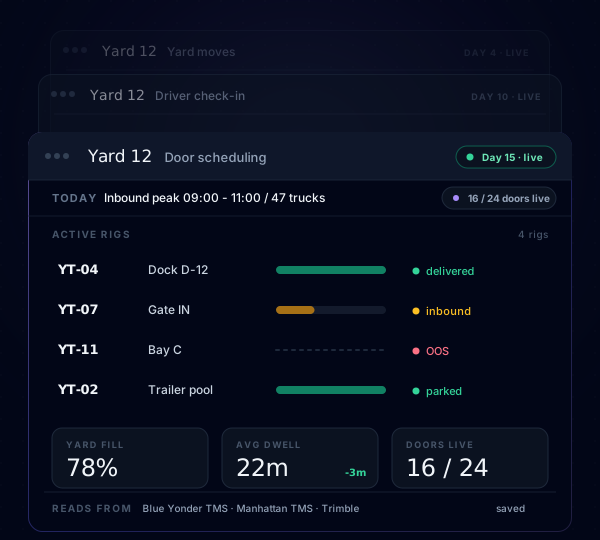
Every door shows its trailer, dwell, and next slot
Receiving, shipping, and cross-dock doors in one board. Yard jockeys see where to spot the next trailer without calling the dock office.
Production-grade ops software, built to fit on top of Blue Yonder TMS, Manhattan TMS, Trimble, or whichever fleet and yard system you already run. We build it. We deploy it. You pay only after it goes live.
THE STATE OF YARD AND DOCK OPERATIONS
Detention at shipping and receiving facilities is the single largest measurable productivity loss in U.S. for-hire trucking, and it lands on the yard and dock teams managing the gate.
of all truck driver stops at customer facilities resulted in detention in 2023, with delays exceeding two hours
industry-wide hours lost to driver detention across U.S. trucking in 2023 alone
in lost productivity to the trucking industry from driver detention in 2023, on top of $3.6B in direct expenses
Source: American Transportation Research Institute (ATRI), "Costs and Consequences of Truck Driver Detention," September 2024 (truckingresearch.org).
WHAT CHANGES AT YOUR YARD
Each capability runs on top of your existing TMS, YMS, and dispatch tools. Nothing rip-and-replace. Nothing your dock crew has to learn from scratch.
DOCK DOORS
Receiving, shipping, and cross-dock doors in one board. Yard jockeys see where to spot the next trailer without calling the dock office.
ROUTE PROGRESS
Dispatchers see route progress with completed stops, remaining stops, and projected delivery window. Late alerts fire before the customer calls.
DRIVER AVAILABILITY
Hours of service, next available window, and current load. Dispatch assigns the next run in seconds, not a round of phone calls.
TRACTOR UPTIME
Every tractor and trailer reports status. Maintenance sees MTTR per unit class. Dispatch sees available power units per yard zone.
SHIFT HANDOVER
Stuck loads, late pickups, downed tractors, and open dock doors. All current, all live. The morning dispatcher starts executing, not reconstructing.
BREAKDOWN ALERTS
Driver reports breakdown. Dispatch sees location and load status. Maintenance sees unit history and nearest service point. One event, two views, zero phone tag.
WHERE YARD OPERATIONS LOSE GROUND
A driver arrives at the gate for a chassis pull. The chassis designated in the TMS was flagged defective by the yard tech three hours ago on the radio. The gate still shows it as available.
"We sent a driver 40 miles to pick up a chassis that was deferred for a brake inspection. Nobody updated the system. The radio call was the system."
Yard Operations Manager
A yard truck breaks down on the back row at 23:00. The night operator radios it in. By 07:00, pre-trip inspections start and the same truck is dispatched until the driver calls in from the fuel lane.
"The biggest source of morning chaos is equipment that broke down overnight and never made it into the dispatch board. The radio call existed. The record didn't."
Fleet Manager
When a container release depends on a specific yard truck or top loader that is down, the delay propagates to the driver, the import team, and the freight forwarder as a chain of phone calls.
"I'm calling five people to figure out why a gate release isn't happening. One call could replace all of them if someone could just see the board."
Terminal Manager
WHAT OPSIMA SHOWS OPERATIONS
Every status update sent over WhatsApp, radio, or email becomes a tile on this board. Operations knows what is available right now: not what was available an hour ago.
FROM RADIO CALL TO WORK ORDER
Field communication flows through Opsima and becomes a structured work order automatically. No forms. No data entry. No end-of-shift catch-up.
PAIN TO OUTCOME
THE GATE RELEASE PROBLEM
The delay hits the driver, the importer, and the freight forwarder. One screen could prevent all of it.
BUILT FOR LOGISTICS TECHNOLOGY STACKS
Opsima does not replace Oracle TM, SAP, or Kaleris YMS. It captures unstructured yard communication and feeds structured records back in.
Chassis and yard equipment status flows into your existing systems. No migration.
They communicate as normal. Opsima reads the output. No behavior change.
All equipment tracked on one board regardless of ownership. Attribution maintained in reporting.
No hardware. Connect to existing communication channels and see structured equipment data within 72 hours.
FAQ
Book a working session with our solution team. We map the yard, the integrations, and the timeline before anything else.