Manufacturing execution

MES software for the plant floor that was only half wired in

Production orders, OEE, downtime reasons, first pass yield and batch traceability, taken from the machines that report and the benches that never could.

  • Runs on your existing stack
  • Live in weeks, not quarters
  • Pay only after go-live
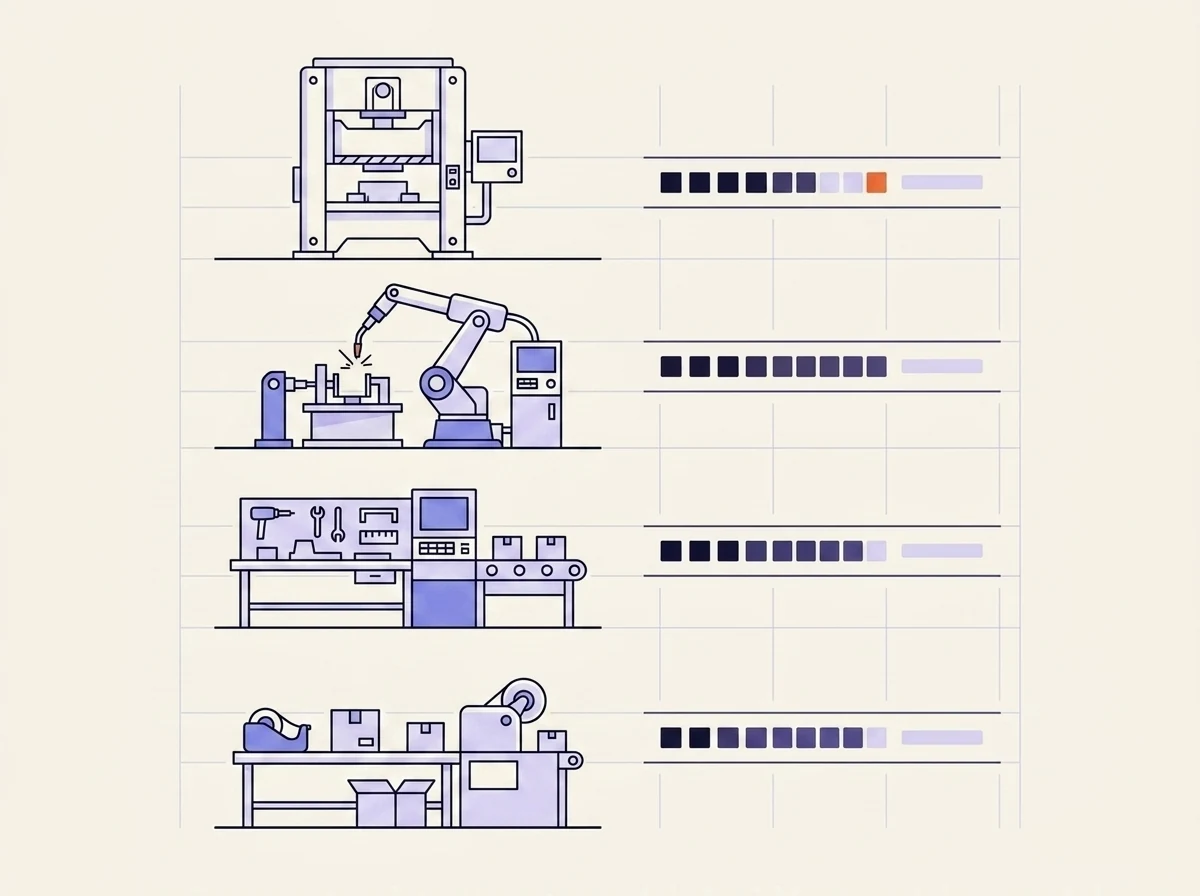
Illustrated production line drawn as line art: four workstations stacked as rows, a press, a robotic weld cell, an assembly bench and a packing station, each with a segmented progress strip beside it, one segment highlighted in orange to mark the station running behind.

The category

What a manufacturing execution system actually covers

A manufacturing execution system (MES) is the software that runs the plant floor between the order and the finished unit. It holds the production order, sequences the work across stations, records what each one actually produced, and closes the order with real numbers.

The line between an MES and an ERP is worth drawing clearly. The ERP plans and settles: the order, the bill of materials, the cost, the invoice. It knows a thousand units are due Thursday. The MES executes, and it is the only system that knows station four is forty units behind and that the reason is a die change that ran ninety-six minutes against a standard of sixty.

The gap

When the plan and the floor stop agreeing

01

The plan says the order finishes Thursday, and the only way to check is to walk the floor.

02

Scrap gets counted at the end of the run, when it is too late to do anything about it.

03

A material batch turns out bad and nobody can say which finished units it went into.

04

Two shifts report the same line differently, and both sets of numbers reach the same meeting.

If two or more of those sound familiar, the problem is rarely the plan. It is that nothing is recording what the floor actually did while it was doing it.

Capabilities

What the platform covers

Nine areas, grouped around the way a shift actually runs instead of around a list of modules.

Production orders

Every order, and where it actually got to

The order broken into its operations, each one showing what has been made against what was planned. When the projected finish drifts past the due date, that shows up while there is still time to move something rather than at the end of the shift.

OEE

Availability, performance and quality, separately

One OEE number tells you something is wrong and nothing about where. Splitting it tells you the line is available and running to rate, and losing points on quality. Built from the records the line already produces rather than a figure assembled once a week.

Downtime

Where the lost hours went

Reasons coded at the line while the operator still remembers, ranked by hours rather than by how often they get mentioned in the morning meeting. Changeover overrun and material not at the line usually beat breakdowns, and usually surprise people.

Quality

Yield that moves when something changes

First pass yield per product and per line, with the events that moved it marked on the same timeline. A new die, a different coil supplier or a new operator on nights all show up as a step in the trend instead of a rumour.

Traceability

Which batch went into which unit

Material lots tied to the orders that consumed them and the serial numbers that came out. When a coating batch turns out bad, the question is which twenty-two units to recall rather than which nine hundred.

Changeover

The time between products, measured

Every changeover timed against the standard, so the ones that consistently overrun become visible. This is the single largest source of lost hours in most plants and the least often measured.

WIP

What is sitting between stations right now

Work in progress by station, so a queue building in front of one machine is something you see forming rather than something you discover when the next station runs dry.

Compliance

Checks recorded as the work happens

In-process inspections, first-off approvals and safety checks captured at the station. The audit trail builds itself while the order runs, so nobody has to assemble it the week before the audit.

ERP

Real numbers back into the ERP

SAP, Oracle, Priority and Infor stay your system of record. Opsima reads the order and the bill of materials from them and writes back what was actually produced, consumed and scrapped. IT reviews and signs off the rollout in staging before it goes live.

The difference

Half the plant floor was never wired in

Every MES on the market handles a connected line well. The PLC reports a count, the system stores it, the dashboard draws the chart. That has been solved for years, and it is why MES demos always look convincing.

Real plants are mixed. A press from 2003 with no network port. A bench where two people assemble sub-units by hand. A rework station that exists because somebody set it up during a bad month and it never went away. A quality check that happens on a clipboard because the gauge is not connected to anything. None of those report, and together they account for a large share of the hours the order took.

Opsima captures those steps through the channels operators already use and writes them onto the same order record as the machine data. That is why the projected finish stops being a guess, and why an order that ran through three unconnected stations still ends up with a complete history.

In the field

At PNCT, recorded equipment status changes went from roughly 1,000 a month to roughly 14,000 once capture matched the way the operation actually works.

That is a terminal rather than a plant, and the mechanism is the same one an MES needs: the work was always happening, and the record was not. Taavura's Earth Moving Division runs the same layer across quarries and infrastructure sites, after ERP integrations had already failed to stick with field crews.

Delivery

Two ways in

Tailor

Build the layer on the MES you already run

Your existing MES stays the system of record for the lines it already covers. Opsima adds capture at the stations that were never wired in and reporting that reads across all of them at once. Nothing gets ripped out, and IT reviews and signs off the rollout in staging before it goes live.

Build

Replace the system you have outgrown

When the platform is the thing holding you back, expensive to change and unable to describe how you actually make things, Opsima builds the replacement around your routings and your stations. It runs on your servers or ours. Working software ships in weeks, and you pay once it earns its place.

Questions from operations and maintenance teams

What is a manufacturing execution system?
A manufacturing execution system (MES) is the software that runs the plant floor between the order and the finished unit. It holds the production order, tells each station what to make and in what sequence, records what actually happened, and reports the result back up. An ERP knows a thousand units are due Thursday. The MES knows that station four is 40 units behind and why.
What is the difference between MES and ERP?
The ERP plans and settles. It holds the order, the bill of materials, the costs and the invoice. The MES executes. It sequences the work, captures what each station produced, records scrap and downtime, and closes the order with real numbers rather than expected ones. Opsima builds the MES layer and writes those real numbers back into whichever ERP you already run.
Do we have to replace our existing MES?
No. Tailor mode adds the missing layer on top of the MES you run today, which is usually capture at the stations that were never wired in and reporting that pulls from all of them at once. Build mode replaces a system you have outgrown, and that is a decision worth taking slowly. Most plants start with tailor mode.
How does this work on a line that is not fully instrumented?
That is the case it is built for. Plenty of plant floors have a mix of connected machines, older equipment with no signal at all, and steps that happen at a bench. Opsima captures the manual steps through the channels operators already use and puts them on the same order record as the machine data, so the order has a complete history rather than a partial one.
Does it calculate OEE?
Yes, and from the same records the line already produces rather than from a separate weekly estimate. Availability, performance and quality are each visible on their own, because an OEE number on its own does not tell you which of the three to go and fix.
How long does an MES implementation take?
Large MES projects are usually quoted in quarters. Opsima ships working software in weeks because each build starts from one line or one order type rather than the whole plant, and it is built around your actual routings instead of configured out of a generic product. You pay once it earns its place.
Working session

Your lines. Your routings.
Software built for them.

Bring one order type where the finish date is always a guess. We build it on your real data and run it with you. You pay only after it goes live.

On your existing stack
Live in weeks, not quarters
Pay only after go-live
Built and run for you