BULK TERMINAL OPERATIONS

Personalized software to run your bulk terminal.

Personalized ops software that captures real-time equipment status from quay communication and feeds it back into SAP PM, Maximo, and Navis BCP.
  • Built to fit your terminal
  • Live in weeks, not quarters
  • Pay only when it works
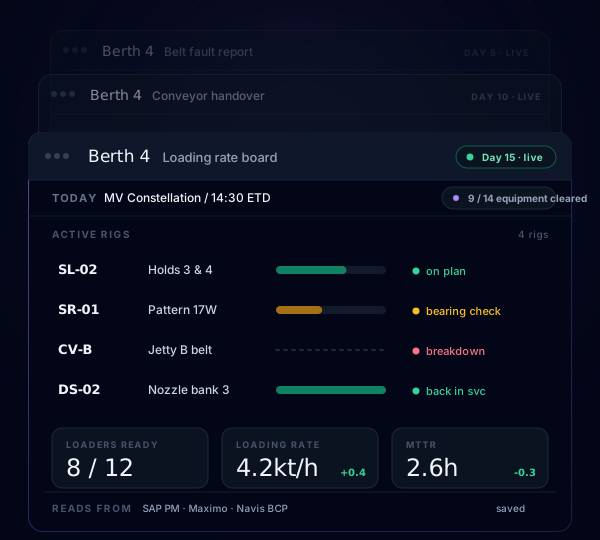
Opsima ops layer reading live data from SAP PM, Maximo, and Navis BCP, surfacing loader readiness, loading rate, and MTTR for Berth 4.

Bulk terminals lose more time per ship than any other cargo type.

Across the bulk terminal industry, the gap between what coordinators know and what is actually happening on the quay shows up directly in vessel time in port.

3x

longer in port for a typical dry bulk carrier than a container ship (UNCTAD, 2023)

2.7 days

average time in port for dry bulk carriers in 2024, versus 1.5 for tankers and 0.9 for breakbulk (UNCTAD, 2025)

$25.7M

average yearly demurrage cost at a single major dry bulk export port over the 10 years to 2020 (Journal of Shipping and Trade, 2024)

Sources: UNCTAD Review of Maritime Transport 2023 and 2025; Journal of Shipping and Trade, 2024

What changes in your bulk operation, week one.

Each capability runs on top of your existing TOS and CMMS. Nothing rip-and-replace. Nothing your quay crew has to learn from scratch.

VESSEL LOADING

Loading rate per hold, updated every 15 minutes

Shiploaders report tonnage by hold and hatch. Coordinators see loading rate against the vessel plan without calling the quay office.

CONVEYOR SYSTEM

Belt status from stockpile to shiploader in one view

Every conveyor shows running, stopped, or faulted. Tonnage throughput per segment visible alongside maintenance alerts. Bottlenecks surface before they cascade.

STOCKPILE LEVELS

Grade, tonnage, and days of cover per pad

Every stockpile shows current tonnage, grade analysis, and projected depletion. Blending coordinators see what is available before they commit to a vessel nomination.

DUST MONITORING

PM10 levels at boundary and quay in real time

Dust monitors report continuously. When readings approach the limit, ops sees which stockpile or conveyor transfer point is the source. Compliance stays ahead of the regulator.

EQUIPMENT UPTIME

Shiploader, stacker, and reclaimer health on one board

Every major unit reports status continuously. Maintenance sees MTTR per asset class. Ops sees available capacity per berth zone.

SHIFT HANDOVER

Incoming coordinator gets vessel, belt, and stockpile status in 2 minutes

Active loading, downed conveyors, grade issues, and weather holds. All live, all current. No 30-minute radio reconstruction at shift change.

Three breakdowns that compound every vessel.

The Loading Rate Collapse

A conveyor belt fault drops loading rate by 40%. The belt operator radios the fault. The maintenance team is on another section of the quay. The vessel master calls the terminal superintendent 25 minutes into the reduced rate.

"The ship was 800 tonnes short of plan and I found out when the master called me. The guy on the belt radioed it in 25 minutes earlier. It just didn't get to me."

Terminal Operations Manager

The Stacker-Reclaimer Scheduling Gap

Reclaim sequences are planned against a stockyard model. Whether the stacker-reclaimer is available is confirmed by radio at plan time and assumed to hold.

"We planned a reclaim sequence for berth 2 on a stacker that was scheduled for a bearing check at 13:00. That information was on the maintenance planner's whiteboard. Not anywhere I could see it."

Port Manager

The Dust Suppression Compliance Gap

Dust suppression systems are a regulatory compliance requirement. When a nozzle bank or pump fails, field crews report it by WhatsApp or radio. Whether the event was logged as a timestamped compliance record depends on manual entry.

"We had an EPA inspection and they asked for the maintenance log on dust suppression Unit 3. It existed as a WhatsApp message from the fitter. That's not a maintenance record."

Maintenance Planner

A live equipment status board built from field communication.

Every status update sent over WhatsApp, radio, or email becomes a tile on this board. Operations knows what is available right now: not what was available an hour ago.

Bulk Terminal Overview LIVE
Available: 0
In Maintenance: 0
Breakdown: 0
Reserved: 0
SL-01
Ship Loader 1
Available
SL-02
Ship Loader 2
In Maintenance
SL-03
Ship Loader 3
Available
SR-01
Stacker-Reclaimer 1
Available
SR-02
Stacker-Reclaimer 2
Reserved
CV-A
Conveyor Jetty A
Available
CV-B
Conveyor Jetty B
Breakdown
CV-C
Conveyor Stockyard C
Available
CV-D
Conveyor Transfer D
In Maintenance
HO-01
Hopper 1
Available
HO-02
Hopper 2
Available
HO-03
Hopper 3
Breakdown
BE-01
Bucket Elevator
Available
SC-01
Slew Crane 1
In Maintenance
SC-02
Slew Crane 2
Available
DS-01
Dust Suppression 1
Available
DS-02
Dust Suppression 2
Breakdown
DS-03
Dust Suppression 3
Available
WH-01
Wharf Crane
Available
MS-01
Mobile Stacker
Reserved

The repair gets reported. The record writes itself.

Field communication flows through Opsima and becomes a structured work order automatically. No forms. No data entry. No end-of-shift catch-up.

Quay Maintenance
Belt Operator
CV-B Jetty B: belt tracking badly, north return roller seized, loading rate dropping
14:06
Supervisor
Fitter dispatched from workshop
14:09
Fitter
On site. Roller seized confirmed, have replacement roller in store. Repair est. 90 min.
14:22
Fitter
CV-B back online, full rate restored
15:58
Asset CV-B
Fault type North return roller seized
Location Jetty B
Technician Fitter
Parts used Replacement roller
Fault reported 14:06
Resolved 15:58
Work Order Record Created
Asset CV-B
Fault type North return roller seized
Location Jetty B
Technician Fitter
Parts used Replacement roller
Fault reported 14:06
Resolved 15:58
Synced to CMMS

What changes when operations and maintenance share one source of truth.

Conveyor fault drops loading rate. Vessel master hears before superintendent
Belt status visible to operations and superintendent the moment the operator radios the fault
Stacker-reclaimer scheduled for maintenance. Reclaim plan committed without knowing
Equipment maintenance reservations visible to planners before reclaim sequences are confirmed
Dust suppression fault exists as a WhatsApp message, not a compliance record
All dust suppression events captured as timestamped, asset-linked records from field communication
Vessel loading shortfall traced hours after the fact from manual CMMS entry
Loading rate disruptions linked to equipment events in real time; root cause visible same shift
PM on rotating equipment tracked against calendar rather than actual usage
PM triggers based on actual tonnage and running hours reported from field communication
Maintenance history for compliance audit compiled from paper and WhatsApp
All maintenance events structured with timestamps, technician attribution, and parts used

The vessel master always finds out about equipment problems before the terminal superintendent does.

That gap is the cost. Opsima closes it by making every equipment status change visible the moment it happens.

Without Opsima
14:00
SL-01
Available
SL-02
?
CV-B
?
SR-02
?
HO-03
?
DS-02
?
CV-D
?
SC-01
?
CV-B has been struggling since changeover. DS-02 was written up this morning. Check with afternoon super before committing reclaim sequence.
Handover complete: 35 minutes
With Opsima
14:00
SL-01
Available
SL-02
In Maintenance
CV-B
Breakdown
SR-02
Reserved
HO-03
Breakdown
DS-02
Breakdown
CV-D
In Maintenance
SC-01
In Maintenance
3 active breakdowns (CV-B, HO-03, DS-02)
CV-B repair underway: roller, ETA 90 min
SR-02 reserved for bearing inspection 15:00
Handover complete: 2 minutes

Overlays your existing stockyard and asset systems. Live in 3 days.

Opsima does not replace SAP PM, Maximo, or Navis BCP. It captures unstructured quay communication and feeds structured records back in.

Integrates with SAP PM, Maximo, Navis BCP, Quintiq / Dematic

Equipment status and maintenance records flow into your existing systems. No migration.

No new hardware on the quay or stockyard

Opsima reads existing communication channels. No sensors, no wiring.

Handles multi-berth, multi-commodity bulk terminals

Automatic asset identification across all berths, stockyards, and commodity streams.

Live in 3 days

No maintenance window. Connect to existing communication channels around live loading operations.

Questions from operations and maintenance teams

How does Opsima handle equipment that spans multiple berths and stockyard zones?
Equipment is tracked by asset ID. Location updates are captured from field communication as equipment moves between berths and zones.
Can it track regulatory compliance events separately from general maintenance?
Yes. Dust suppression, environmental, and safety-critical events can be flagged for separate compliance reporting with full audit trails.
Does it integrate with our vessel scheduling system?
Opsima focuses on equipment status. It can feed availability data into systems that reference vessel loading schedules for integrated planning.
How does it work for multi-commodity bulk terminals?
Equipment is tracked independently of commodity type. The board shows all equipment regardless of which commodity stream it serves.
What does implementation look like for a 24/7 continuous loading operation?
No maintenance window required. Opsima connects to existing communication channels around live loading. First structured data within 72 hours.
Ready to ship

Personalized ops software for your bulk terminal. Live in weeks, paid for when it works.

Book a working session with our solution team. We map the terminal, the integrations, and the timeline before anything else.

SSO Isolated environments Audit trails Dev → Review → Prod